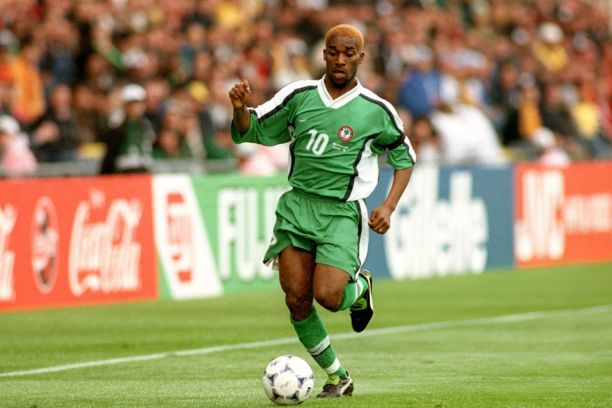
Nigeria has produced some of Africa’s most talented footballers, but few positions have delivered as much quality, creativity, and unforgettable brilliance as midfield.
Over the decades, the Super Eagles have been blessed with exceptional players who could control matches, unlock stubborn defences, and produce extraordinary performances when their country needed them most.
From the dazzling skills of Jay-Jay Okocha to the commanding presence of Sunday Oliseh and the remarkable consistency of John Obi Mikel, Nigeria’s midfield history is filled with extraordinary stories.
These players inspired generations, competed against the world’s finest footballers, and helped establish Nigeria as one of Africa’s most respected footballing nations.
The history of Nigerian football would be incomplete without recognising the midfielders who contributed to the country’s greatest achievements. Some helped Nigeria win the Africa Cup of Nations (AFCON), others delivered unforgettable FIFA World Cup performances, while several became household names through their achievements in European football.
Choosing the best midfielders in the country’s history is not simply about counting goals, assists, or trophies. Midfielders perform different responsibilities, and their contributions often extend beyond traditional statistics.
This ranking considers international performances, technical ability, consistency, leadership, major tournament contributions, and lasting influence, and recognises early Green Eagles generations as well as the modern Super Eagles.
Top 7 Super Eagles Midfielders of All Time!
- Austin Jay-Jay Okocha
- John Obi Mikel
- Sunday Oliseh
- Muda Lawal
- Henry Nwosu
- Mutiu Adepoju
- Alex Iwobi
7. Alex Iwobi
A versatile modern playmaker
Alex Iwobi has gradually established himself as one of the most influential Nigerian midfielders of his generation. Although his career is still ongoing, his technical intelligence, versatility, and contributions to the national team deserve recognition.
Born in Lagos in 1996, Iwobi moved to England at a young age and developed through Arsenal’s academy before making his senior breakthrough in 2015. His close control, composure, and awareness of space helped him progress from a wide attacking role into a more rounded central midfielder.
His rise through English football
At Arsenal, Iwobi earned regular minutes under Arsène Wenger and contributed to the club’s 2017 FA Cup triumph. He joined Everton in 2019 and gradually developed into one of the team’s most important progressive passers and ball carriers.
His 2023 move to Fulham gave him a platform to sharpen his central midfield responsibilities. Under Marco Silva, Iwobi’s passing, tactical movement, defensive work, and attacking combinations continued to mature.
His importance to Nigeria
Iwobi chose to represent Nigeria after playing youth football for England. One of his defining international moments came in October 2017, when his goal against Zambia secured qualification for the 2018 World Cup.
He subsequently represented Nigeria at the 2018 tournament and several AFCON competitions, including the 2019 bronze-medal campaign and the run to the 2023 edition’s final, played in 2024. By June 2026, he had reached 100 senior international appearances. His ability to connect midfield and attack has made him an essential creative option for the Super Eagles.
6. Mutiu Adepoju
The dependable midfield star
Few Nigerian midfielders combined technical ability, aerial strength, and tactical discipline as effectively as Mutiu Adepoju. Nicknamed “The Headmaster,” he was an important member of Nigeria’s celebrated 1990s generation.
Playing beside Jay-Jay Okocha, Sunday Oliseh, Rashidi Yekini and Finidi George, he contributed intelligent movement, physical presence, and a strong understanding of the game.
A remarkable career in Spain
Born in Ibadan in 1970, Adepoju began his career in Nigeria before moving to Spain. He joined Real Madrid Castilla in 1989, and later represented Racing Santander, Real Sociedad and Salamanca. At Racing, he helped the club secure promotion to La Liga. Adepoju’s success in Spanish football illustrated his capacity to adjust to highly technical and tactically disciplined competition. He could defend, support attacks, make late runs into the box, and provide an aerial threat from crosses.
The unforgettable 1998 World Cup
Adepoju represented Nigeria at the 1994, 1998 and 2002 FIFA World Cups. His unforgettable headed goal against Spain in 1998 brought Nigeria level during a dramatic group-stage match. Nigeria eventually prevailed 3–2 after Sunday Oliseh’s long-range winner. That victory remains one of the most celebrated results in the history of the Super Eagles. Adepoju also helped Nigeria win the 1994 AFCON, giving him an enduring place among the country’s tournament heroes.
5. Henry Nwosu
A creative pioneer
Long before supporters celebrated the flair of Jay-Jay Okocha, Henry Nwosu entertained fans with close control, fine passing and imaginative attacking play. His emergence came as Nigeria was becoming a respected force in African football. Nwosu could carry the ball through difficult areas, take responsibility in possession and identify opportunities before defenders recognised them.
A teenage star in the 1980 victory
Nwosu was the youngest player in Nigeria’s squad for the 1980 Africa Cup of Nations. The hosts beat Algeria 3–0 in the final in Lagos, winning their first continental championship. That occasion was a watershed in Nigerian football. It was also an extraordinary early achievement for a teenager whose international career would span several major competitions.
Technical ability and tournament legacy
Nwosu developed into a dependable creative influence for Nigeria through the 1980s. He was part of the teams that reached the AFCON finals in 1984 and 1988, both lost to Cameroon. His left-sided creativity, range of passing, ability with either foot and feel for the tempo of a match won praise from teammates and supporters. He offered a kind of ingenuity that would become a familiar characteristic of later Nigerian attacking midfielders.
Why Henry Nwosu ranks fifth
Nwosu deserves fifth place for his role in Nigeria’s breakthrough continental title and his influence across three AFCON final appearances. He represents a generation whose achievements are sometimes overshadowed by the global visibility of Premier League-era football players. Nwosu died in March 2026, leaving a legacy of attacking creativity and national service.
4. Muda Lawal
An influential all-rounder
Mudashiru Babatunde Lawal, known as Muda Lawal, remains among Nigeria’s most revered football figures. Born in Abeokuta in 1954, he developed a reputation for tireless running, tactical awareness, resilience and an ability to contribute at both ends of the pitch. Much of his club career was spent in Nigeria, particularly with Shooting Stars, demonstrating that greatness was not limited to European leagues.
The engine of Nigeria’s first AFCON title
Lawal was central to Nigeria’s triumphant 1980 Africa Cup of Nations campaign. He contributed energy and attacking runs throughout the tournament and scored in the final against Algeria as Nigeria won 3–0. The title helped establish Nigeria among the continent’s strongest teams. His directness and willingness to take responsibility from midfield made him a valuable part of the historic side.
An exceptional international record
Lawal appeared at five consecutive Africa Cup of Nations tournaments from 1976 to 1984, a remarkable achievement across several demanding competition cycles. He also helped Shooting Stars win the 1976 African Cup Winners’ Cup, the first continental club trophy won by a Nigerian team. Historical records differ slightly on his goal total, but widely used international statistics list 86 appearances and 11 goals.
3. Sunday Oliseh
Tactical intelligence and control
Sunday Oliseh brought discipline, authority and an exceptional passing range to Nigeria’s golden generation. While the attacking players captured headlines, he gave the team defensive balance. He knew when to intercept, tackle, retain possession or release an early forward pass. His positioning helped talented teammates express themselves without leaving the back line unprotected.
From Nigeria to elite European clubs
Born in Abavo in 1974, Oliseh played in Belgium, Italy, Germany and the Netherlands. His time at Ajax helped sharpen his understanding of positional football and technical circulation. He later represented Juventus and Borussia Dortmund, competing within some of Europe’s most demanding environments. Oliseh demonstrated that defensive midfielders from Nigeria could combine athletic power with sophistication in possession.
Nigeria’s golden generation
Oliseh was part of the 1994 Africa Cup of Nations-winning squad and Nigeria’s first World Cup campaign later that year. He also helped the Olympic team claim gold at Atlanta 1996. Across these competitions, he protected the defence and allowed attacking stars including Jay-Jay Okocha and Finidi George to take calculated risks. His leadership and communication strengthened the collective organisation of the national team.
The legendary goal against Spain
His most famous moment arrived at the 1998 World Cup. With Nigeria and Spain level at 2–2, Oliseh struck a superb long-range shot past Andoni Zubizarreta to seal a 3–2 win. The combination of power, timing and context made the goal unforgettable. It remains one of Nigeria’s signature World Cup moments and epitomises his willingness to take responsibility when it mattered.
Why Sunday Oliseh ranks third
Oliseh ranks third for his tactical mastery, international achievements and prominent European career. His contribution was often measured through organisation rather than attacking statistics. He later captained Nigeria and briefly managed the national team. For the Super Eagles, his name remains associated with intelligence, leadership and one of the greatest goals in the country’s history.
2. John Obi Mikel
A model of elite consistency
John Obi Mikel stands among Nigeria’s most accomplished modern footballers. His style depended on composure, tactical awareness, physical strength and the ability to protect possession under pressure. Rather than collecting spectacular individual highlights, he made teams function through dependable positioning and measured distribution.
From youth star to Chelsea legend
Born in Jos in 1987, Mikel excelled at the 2005 FIFA World Youth Championship as Nigeria reached the final. His performances attracted major European interest, and he joined Chelsea in 2006. At Stamford Bridge, he developed into a specialist defensive midfielder who combined ball retention with the awareness to shield the defence. He worked successfully under multiple managers and alongside established stars including Frank Lampard and Didier Drogba.
An extraordinary trophy collection
Mikel won two Premier League titles, four FA Cups, the UEFA Champions League and the UEFA Europa League at Chelsea. One of his finest games came in the 2012 Champions League final against Bayern Munich, when his disciplined display helped Chelsea survive sustained pressure before winning on penalties. His performance illustrated the value of defensive control and composure in the biggest matches.
Leading Nigeria to the 2013 AFCON title
Mikel played a defining role in Nigeria’s 2013 Africa Cup of Nations triumph under Stephen Keshi. Unlike his restrictive role at Chelsea, he enjoyed greater licence to control Nigeria’s attacking rhythm. His passing and assured presence helped the team overcome Côte d’Ivoire and Mali before defeating Burkina Faso 1–0 in the final through Sunday Mba’s goal. Mikel later captained Nigeria and led the Olympic squad to bronze at Rio 2016.
1. Austin Jay-Jay Okocha
The genius of Nigerian midfield play
Augustine Azuka Okocha, known worldwide as Jay-Jay Okocha, possessed an uncommon combination of imagination, dribbling skill, composure and joy. He could transform a routine passage of play into an unforgettable piece of football. His trademark feints, balance and close control intimidated defenders and delighted supporters. Crucially, his creativity was not merely decorative: he regularly used it to create space, beat opponents and produce chances.
From Enugu to European stardom
Born in Enugu in 1973, Okocha built a professional career spanning Germany, Turkey, France, England and Qatar. At Eintracht Frankfurt, he produced one of the Bundesliga’s most famous solo goals against Karlsruhe in 1993. Later spells at Fenerbahçe and Paris Saint-Germain brought him international prominence. At PSG, he played alongside the emerging Ronaldinho and became known as a creative force with the confidence to face almost any defender.
Becoming a Bolton icon
Okocha joined Bolton Wanderers in 2002 and became one of the Premier League’s outstanding entertainers. His flamboyant touches were matched by meaningful contributions to a competitive side. He could break pressure in tight spaces, deliver incisive passes, shoot from distance and threaten from free kicks. He eventually captained the club, reflecting his status as an influential teammate as well as a crowd favourite.
Nigeria’s golden generation
Okocha was part of Nigeria’s 1994 AFCON-winning squad and took part in the nation’s historic World Cup debut later that year. His boldness in possession gave Nigeria something opponents found difficult to predict. He remained integral through the 1998 World Cup and later continental tournaments, emerging as one of the best-known representatives of the Super Eagles around the world.
Individual brilliance at the 2004 AFCON
Okocha’s leadership reached a particularly memorable height at the 2004 Africa Cup of Nations in Tunisia. He scored four times as Nigeria finished third and was recognised as the tournament’s Best Player. His performances combined the inventiveness of his younger years with the responsibility of an experienced national captain. He could influence a game through a single dribble or an intelligently weighted pass.
Why Okocha was different
Opponents often could not tell whether Okocha would pass, turn, dribble, shoot or change direction. Yet his football intelligence was just as important as his spectacular technique. He understood when to slow the tempo, when to invite pressure, and when to attack an opening. His style became a symbol of flair in African football and inspired generations of younger Nigerian players.
Honourable Mentions: Other Legendary Nigerian Midfielders
Garba Lawal deserves particular recognition for his versatility, work rate and success with Nigeria’s 1996 Olympic gold-medal side. Friday Ekpo also contributed flair and intelligent passing during the late 1980s and early 1990s. Wilfred Ndidi has distinguished himself in the modern era through ball-winning, interceptions and tactical discipline. These players further demonstrate the breadth of talent across Nigeria’s midfield history.
Conclusion
From the breakthrough exploits of Muda Lawal and Henry Nwosu to the tactical intelligence of Sunday Oliseh, the consistency of John Obi Mikel and the exhilarating creativity of Jay-Jay Okocha, Nigeria has produced truly remarkable midfielders. Their contributions helped the Super Eagles win continental titles, excel on the World Cup stage, and earn international respect.
Although fans will disagree about the final order, Okocha leads our ranking because his skill, imagination and influence helped define a footballing generation. Future talents can build upon the foundations established by these seven legends and add new chapters to the story of the Super Eagles of Nigeria.
Image Credit: GettyImages
Read more here: 20 Best Nigerian Soccer Players
Frequently Asked Questions
Question 1: Who is the greatest Super Eagles midfielder of all time?
Ans: Jay-Jay Okocha ranks first in this editorial selection because of his creativity, influence and outstanding technical ability. John Obi Mikel and Sunday Oliseh are also compelling contenders.
Question 2: Who is the most decorated Nigerian midfielder?
Ans: John Obi Mikel is among the most decorated. His honours include the UEFA Champions League, UEFA Europa League, two Premier League titles, four FA Cups and the 2013 Africa Cup of Nations.
Question 3: Who scored Nigeria’s winning goal against Spain at the 1998 World Cup?
Ans: Sunday Oliseh scored the decisive long-range goal in Nigeria’s dramatic 3–2 victory.
Question 4: Which Nigerian midfielder played in five consecutive AFCON tournaments?
Ans: Muda Lawal appeared in five consecutive Africa Cup of Nations competitions from 1976 through 1984.
Question 5: Who are Nigeria’s notable modern midfielders?
Ans: John Obi Mikel, Alex Iwobi and Wilfred Ndidi are among the country’s most influential modern-era midfielders.
Related Articles
Nigerian Jersey: Best 7 Kits of All Time!
Ranked! 5 Greatest Super Eagles Squads Ever
Top 11 Greatest Nigerian Goalkeepers of All Time!
What the Super Eagles’ Recent Friendlies Reveal About Their Defense