Nigeria have rarely struggled for individual football talent. The bigger challenge has often been turning that talent into a balanced, predictable and competitive national team. Since taking charge, Eric Chelle has gradually started changing that equation.
His approach to the Super Eagles goes beyond simply choosing Nigeria’s biggest names. He is creating competition for positions, experimenting with different tactical structures, introducing younger players and demanding that even established stars prove their value within the system.
The result is a Nigerian side that increasingly looks less dependent on reputation and more focused on roles, combinations and tactical fit.
Chelle’s rebuilding process has not been perfect. Nigeria failed to qualify for the 2026 FIFA World Cup, while the 2025 Africa Cup of Nations ended with a bronze medal rather than the trophy supporters wanted. Yet there are clear signs that the national-team hierarchy is changing.
Players who previously appeared almost guaranteed to start now face stronger competition. Young defenders are being trusted. The midfield is becoming more flexible.
Nigeria’s enormous pool of forwards is being assessed according to how players complement one another rather than simply how many goals they score for their clubs.
For anyone following the latest on Super Eagles, the most important story may therefore not be one particular result. It is how Chelle is gradually changing what it takes to become a Nigerian international — and, more importantly, what it takes to remain one.
Who Is Eric Chelle?
Eric Sékou Chelle was appointed Nigeria head coach in January 2025, taking charge of a national team that was already under significant pressure because of its difficult position in the 2026 FIFA World Cup qualifying campaign.
Before Nigeria, Chelle had managed Mali and led them to the quarter-finals of the 2023 Africa Cup of Nations.
His appointment generated plenty of debate. Nigeria have frequently appointed European coaches or former Nigerian internationals, making Chelle’s arrival a somewhat different choice.
What quickly became more important than the debate surrounding his appointment, however, was his football.
Instead of attempting to completely reinvent Nigerian football, Chelle initially concentrated on creating clearer relationships between the country’s strongest players.
His early solution was a narrow midfield structure often described as a 4-4-2 diamond or 4-3-1-2. It allowed Nigeria to put more attacking talent closer to goal while giving midfielders defined responsibilities.
Over time, however, Chelle demonstrated that the formation itself was not sacred. He has also used variations including a 4-3-3 and other midfield arrangements depending on the opponent and available personnel.
Against Rwanda in September 2025, for example, he moved away from the diamond towards a 4-3-3 built around Wilfred Ndidi, Frank Onyeka and Alex Iwobi in midfield.
That willingness to change has become an important part of the evolution of the Super Eagles.
Eric Chelle Is Building a System, Not Just a Starting XI
Perhaps the biggest difference in Chelle’s approach is his apparent determination to move away from the idea that Nigeria should have 11 automatic starters.
That philosophy was particularly visible during the 2025 Africa Cup of Nations. Chelle publicly emphasised that tournament football could not be approached as though only the starting XI mattered. His argument was essentially that substitutes, rotation players and tactical alternatives could become decisive as a competition developed.
This sounds straightforward, but it represents an important change for Nigeria.
National teams sometimes become trapped by reputation. Once a group of players performs well together, coaches can become reluctant to make changes even when club form declines or another player offers something tactically different.
Chelle appears determined to make competition permanent.
That approach means the Super Eagles lineup is becoming less about asking, “Who are Nigeria’s 11 biggest players?” and more about asking, “Which combination gives Nigeria the best chance of winning this particular match?”
The distinction matters.
Against a team defending deep, Nigeria may require extra creativity around the penalty area. Against stronger opponents, Chelle may prioritise midfield aggression, compactness and transition speed. Another match may require natural width, while certain opponents can be attacked with two central strikers.
The result is a starting XI that can change without necessarily representing a change in overall footballing philosophy.
A Tactical Shift Towards a More Aggressive Nigeria
One of Chelle’s clearest influences has been the attempt to make Nigeria more proactive.
Under previous systems, particularly during the run to the 2023 AFCON final played in early 2024, Nigeria frequently relied on defensive organisation, a back three and counter-attacking opportunities.
That approach delivered results, but it could also leave Nigeria struggling to control matches against opponents who surrendered possession.
Chelle has generally looked for something different.
The Super Eagles still possess devastating counter-attacking players, but his teams have increasingly tried to combine that natural transition threat with more structured possession and aggressive forward movement.
At the 2025 AFCON in Morocco, the effectiveness of that approach became difficult to ignore. Nigeria scored 14 goals on their way to the semi-finals, with CAF describing Chelle’s team as the tournament’s most prolific attacking side at that stage.
Nigeria’s 4-0 round-of-16 victory over Mozambique provided perhaps the clearest example. Ademola Lookman opened the scoring, Victor Osimhen scored twice and Akor Adams completed the result as Nigeria controlled the match from the opening stages.
The objective is not simply to attack more. It is to get Nigeria’s best attackers into positions where their qualities complement rather than obstruct one another.
Why Victor Osimhen Remains the Centrepiece
Competition may be increasing everywhere, but Victor Osimhen remains extraordinarily difficult to displace.
Nigeria have several talented centre-forwards, yet Osimhen offers a combination that few can reproduce.
His penalty-box movement makes him dangerous even when he receives relatively few touches. His willingness to run behind defenders stretches opposition back lines. He presses aggressively, attacks crosses and can turn apparently harmless situations into scoring opportunities.
More importantly, his movement creates space for others.
When Osimhen pushes a centre-back towards goal, an attacking midfielder can occupy the space in front of the defence. When he moves into a channel, another forward can attack centrally.
That makes him particularly important to Chelle’s narrow attacking formations.
Rather than treating the striker as somebody who simply finishes chances, Chelle can use Osimhen as the reference point around which the entire Super Eagles attack moves.
Nigeria’s challenge is therefore not necessarily finding another Osimhen. It is developing alternatives so that the team can operate effectively when he is unavailable while also finding partners who maximise his strengths when he plays.
Ademola Lookman’s Role Is Becoming More Flexible
Ademola Lookman represents another fascinating part of Chelle’s tactical project.
Traditionally described as a winger, Lookman possesses qualities that make him effective in several attacking positions. He can start wide and cut inside, operate behind a striker or move into central spaces where defenders find it difficult to decide who should track him.
That versatility is extremely valuable in a narrow formation.
Instead of asking Lookman to remain attached to the touchline, Chelle can allow him to receive possession closer to goal.
The benefit is obvious.
Lookman becomes another scoring threat alongside Osimhen, but he can also drop between midfield and defence to help connect Nigeria’s possession.
At the 2025 AFCON, Nigeria’s attacking combinations involving Osimhen, Lookman and Akor Adams helped make the team exceptionally productive before the semi-final.
For supporters checking Super Eagles today, one of the most interesting tactical questions going forward will be exactly where Chelle believes Lookman is most dangerous.
He does not necessarily have to answer that question with one permanent position.
Lookman’s value may lie precisely in making the answer unpredictable.
Alex Iwobi Is Becoming the Connector
For years, discussions around Alex Iwobi have centred on where he should play.
Is he a number 10? A central midfielder? A wide midfielder? Someone who should operate deeper and progress possession?
Under Chelle, the answer increasingly appears to be that Iwobi’s intelligence makes rigid positional labels less important.
Iwobi gives Nigeria something valuable: connectivity.
He can receive possession from defenders, turn away from pressure, progress the ball through midfield and appear higher up the pitch to combine with attackers.
Chelle himself has publicly referred to the quality available in Nigeria’s midfield while discussing how difficult it has become for new players to break into the squad. The existing competition includes Iwobi, Wilfred Ndidi, Frank Onyeka and several younger options.
That competition could actually benefit Iwobi.
Instead of asking him to perform every creative responsibility, Chelle can construct midfield combinations that allow him to concentrate on what he does particularly well.
In one match, that could mean progressing possession from deeper areas. In another, he may operate closer to the forwards.
The Super Eagles become much harder to defend when Iwobi is connecting rather than carrying the entire creative burden.
Wilfred Ndidi Provides the Tactical Insurance
Attacking freedom requires defensive protection.
That is where Wilfred Ndidi remains particularly valuable.
Nigeria possess numerous attacking players who naturally want to move forward. Full-backs overlap. Midfielders make progressive runs. Lookman drifts towards dangerous spaces. Osimhen constantly attacks the opposition defence.
Somebody has to protect the structure behind those movements.
Ndidi can perform that role.
His positional discipline allows other midfielders to move. His experience helps Nigeria manage transitions. He can screen the centre-backs while also competing for second balls when attacks break down.
Chelle has also been willing to surround Ndidi with energetic midfielders such as Frank Onyeka or Raphael Onyedika when greater physical intensity is required.
That creates an interesting tactical trade-off.
Nigeria can choose additional creativity or additional control without completely changing the system.
For the Super Eagles, that flexibility could prove especially useful during AFCON qualification, where away fixtures can demand a very different approach from home games against defensive opponents.
The Midfield Is No Longer a Closed Club
One of the strongest indications that Chelle is genuinely rebuilding Nigeria is the number of younger midfielders being introduced around the established group.
Players including Ebenezer Akinsanmiro and Tochukwu Nnadi have received opportunities around the senior squad, while Chelle has continued looking beyond the familiar names.
His 54-man preliminary squad for the 2025 AFCON included Akinsanmiro, Nnadi and several other emerging midfield options alongside Ndidi, Iwobi, Onyeka, Onyedika and Fisayo Dele-Bashiru.
The experimentation continued in 2026.
For the Unity Cup and subsequent European friendlies, Chelle again selected combinations containing established internationals and newer players.
This matters because strong national teams rarely remain strong by waiting until their senior players decline before introducing replacements.
The transition has to begin earlier.
Akinsanmiro does not need to immediately replace Iwobi to make his inclusion valuable. Nnadi does not need to become an automatic starter immediately either.
They need minutes, exposure and familiarity with the national-team environment.
That is how the Super Eagles can develop genuine succession planning rather than scrambling for replacements whenever a veteran drops out.
Benjamin Fredrick Symbolises Chelle’s New Meritocracy
Few players better represent Chelle’s willingness to reward opportunity than Benjamin Fredrick.
The young defender rapidly moved from being considered a prospect to becoming a serious senior international option.
By June 2026, Chelle was mentioning Fredrick alongside established central defenders such as Calvin Bassey, Semi Ajayi and Igoh Ogbu when explaining just how difficult competition for places had become.
That is significant.
Young players are often invited to national-team camps without genuinely threatening established starters. Chelle’s approach suggests that age or international experience alone will not guarantee anyone a position.
If a younger player performs, he can move up the hierarchy.
This introduces pressure throughout the squad.
A senior defender cannot assume that 40 international appearances automatically outweigh a younger player’s current performance.
For the Super Eagles of Nigeria, that kind of internal competition could become one of Chelle’s most important long-term contributions.
Calvin Bassey Is Central to the Defensive Rebuild
While younger defenders are emerging, Calvin Bassey remains one of the most important pieces of the Nigerian defence.
Bassey combines physical power with mobility and experience at a high club level. He is also comfortable defending large spaces, something that becomes especially important when Nigeria pushes more players forward.
An attacking team inevitably leaves defenders exposed more frequently.
That means Chelle’s centre-backs cannot simply dominate aerially. They need enough mobility to defend transitions, enough composure to participate in possession and enough tactical awareness to cover the spaces created by advancing full-backs.
Bassey fits that profile.
The more interesting question concerns who plays alongside him.
Semi Ajayi brings experience. Fredrick represents a younger option. Igoh Ogbu and Emmanuel Fernandez add further competition.
The answer may change depending on form and opponent, which reinforces Chelle’s broader philosophy: positions should be competed for rather than permanently assigned.
The Full-Back Positions Could Define the Entire System
Nigeria’s full-backs have enormous importance in Chelle’s narrower tactical structures.
When a team uses two central strikers and an attacking midfielder, natural width can disappear.
The full-backs therefore become responsible for stretching the opposition.
Ola Aina’s ability to advance with the ball, combine in wide areas and still defend one-on-one makes him an obvious asset when available. Bright Osayi-Samuel offers another dynamic option, while Bruno Onyemaechi and Zaidu Sanusi provide alternatives on the opposite side.
Chelle’s own comments about squad competition have highlighted exactly how crowded these positions are.
This competition gives the Super Eagles tactical options rather than simply depth.
A more attacking full-back can be selected when Nigeria expect to dominate possession. A more conservative choice may make sense against dangerous wide attackers.
The full-back decision can therefore change the personality of the entire formation without requiring Chelle to change all 11 players.
Goalkeeper Competition Is Becoming Broader
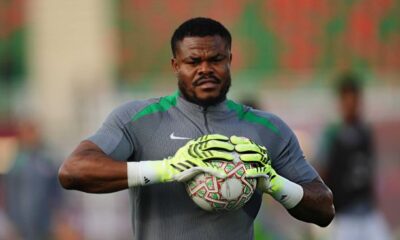
Stanley Nwabali’s emergence gave Nigeria stability in a position that had generated considerable debate for several years.
His penalty saves against Egypt were decisive as Nigeria secured the bronze medal at the 2025 AFCON following a goalless third-place match. Nigeria won the shootout 4-2.
But Chelle has not stopped looking for alternatives.
Maduka Okoye remains part of the senior picture, while Arthur Okonkwo was brought into the squad during the 2026 summer programme and made his senior debut during the Unity Cup.
Competition between goalkeepers is valuable because the position requires more than shot stopping.
As Nigeria attempt to build attacks more deliberately, Chelle may increasingly assess distribution, command of the penalty area, decision-making under pressure and the goalkeeper’s ability to participate when opponents press high.
The Super Eagles therefore appear to be developing options rather than depending entirely on one goalkeeper.
Why Chelle Keeps Introducing New Players
Chelle explained in June 2026 that his wave of new call-ups followed a broader review of Nigeria’s performances and an attempt to improve the squad’s overall level.
That provides useful context.
This is not simply youth development for its own sake.
The objective is competition.
If an established international knows that several players are capable of replacing him, training standards rise. Club form becomes more important. Tactical discipline matters more.
It also gives the coaching staff contingency options.
Injuries can destroy national-team plans because international coaches have very little preparation time. Building a wider group of players who already understand Chelle’s principles reduces that risk.
That makes the latest on Super Eagles call-ups particularly important.
Some invitations may not produce immediate starters. Their bigger purpose may be expanding the number of players Chelle can confidently use when competitive fixtures arrive.
The AFCON 2025 Campaign Showed Both Progress and Limits
Nigeria’s 2025 AFCON campaign offered compelling evidence of progress.
The team advanced to the semi-finals after producing impressive attacking performances, including the 4-0 victory over Mozambique and a 2-0 quarter-final win against Algeria.
But the semi-final against Morocco demonstrated the other side of tournament football.
Nigeria and the hosts could not be separated through 120 minutes, with Morocco eventually winning 4-2 on penalties.
Nigeria recovered to defeat Egypt on penalties in the third-place match and claim bronze.
The campaign therefore produced two truths.
Chelle had built a team capable of playing attractive, effective attacking football.
But Nigeria still needed to become better at turning high-level performances into trophies.
For supporters assessing the Super Eagles AFCON project, that distinction is critical.
The objective is no longer merely to make Nigeria competitive.
Nigeria expect to win.
Missing the 2026 World Cup Changed the Rebuilding Timeline
Nigeria’s failure to qualify for the 2026 FIFA World Cup inevitably reshaped the national-team conversation.
For a country with Nigeria’s footballing talent, missing the world’s largest tournament is a major disappointment.
But the absence also changes Chelle’s planning horizon.
Instead of preparing for a World Cup, Nigeria can devote greater attention to building towards AFCON 2027 and, eventually, qualification for the 2030 World Cup.
That may partly explain the aggressive experimentation seen during 2026.
The Unity Cup, the friendlies against European opposition and the introduction of younger players provided opportunities to test combinations without the immediate pressure of World Cup tournament preparation.
Nigeria’s next generation therefore does not have to wait until the current core disappears.
The transition is already happening.
AFCON 2027 Is the Next Major Test
Nigeria have been drawn with Madagascar, Tanzania and Guinea-Bissau in qualifying for the next Africa Cup of Nations.
Those fixtures will provide a clearer measurement of whether Chelle’s experimentation has translated into a stronger competitive team.
Qualification should be the minimum expectation.
The more interesting questions concern performance.
Can Nigeria control matches against teams defending deep?
Can the midfield consistently progress possession?
Can younger players maintain their places when experienced internationals return?
Can the team create goals without becoming dependent on Osimhen?
And can Chelle maintain defensive stability while committing more players to attack?
Those are the questions that will determine whether the Super Eagles rebuild becomes genuinely transformative.
Final Thoughts
Eric Chelle’s Nigeria project is gradually moving from reconstruction towards competition.
He inherited a team under pressure, experimented with a different tactical structure, created a more aggressive attacking identity and eventually guided Nigeria to third place at the 2025 Africa Cup of Nations.
The disappointment of missing the 2026 World Cup remains significant, but Chelle’s response has been revealing.
Rather than protecting an established group, he has widened the selection pool.
The 2026 Unity Cup introduced fresh players. European friendlies provided another testing environment. Established internationals now know that younger alternatives are emerging behind them.
The next stage is converting that competition into consistency.
AFCON 2027 qualification will provide an important examination, but the larger objective extends beyond one tournament.
Nigeria want a team capable of challenging for African titles while developing another generation strong enough to return the country to the World Cup.
If Chelle succeeds, his most important contribution may not be discovering one spectacular new player or inventing one revolutionary formation.
It may be establishing a culture in which every position has genuine competition, every player understands his tactical responsibilities and no starting place is guaranteed simply because of reputation.
That would represent a meaningful transformation of the Super Eagles — from a collection of exceptional Nigerian footballers into a deeper, more adaptable and genuinely competitive national team.
Read more on Super Eagle’s performance at CAF AFCON 2025
Image Credit: GettyImages
Related Articles
Was Erling Haaland Robbed of Ballon d’or in 22/23 Season?
Top 12 Most Influential Football Players of All Time
Top 9 Goalscorers in FIFA World Cup 2026