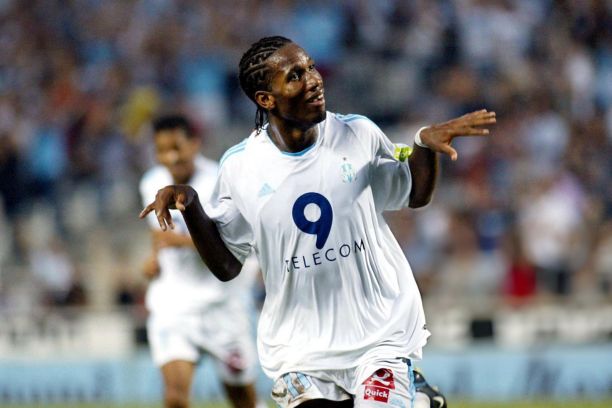
France has long been one of the most important destinations for African talent, creating a relationship between Ligue 1 and African football that stretches back generations.
From prolific pioneers such as Hassan Akesbi and Salif Keita to global icons such as George Weah, Abedi Pelé, Didier Drogba and Jay-Jay Okocha, African stars have helped shape the identity of Ligue 1 while using France as a stage from which to conquer the wider football world.
Some arrived in France as relatively unknown prospects. Others became champions, top scorers, individual award winners and club legends. Many went on to become some of the most celebrated football players the continent has ever produced.
But who deserves to be considered the greatest African player in Ligue 1 history?
This ranking considers performances in the French top flight rather than simply what each player achieved later in England, Italy, Spain or elsewhere. Goals, individual awards, titles, longevity, influence and historical significance all matter.
Africa’s Extraordinary Relationship With Ligue 1
Few major European leagues have been as closely connected to Africa as the French championship. Ligue 1’s own historical research notes that 1,478 African players from 37 countries had appeared in the competition from 1947/48 through the 2023/24 season. Senegal alone had supplied more than 200 players.
That relationship has allowed generations of African football stars to establish themselves in France.
The connection goes beyond geography and language. French clubs have historically recruited throughout West, North and Central Africa, while players from countries including Senegal, Mali, Algeria, Morocco, Cameroon, Ghana, Côte d’Ivoire, Nigeria, Congo and Liberia have become important figures at some of the biggest clubs in French football.
The goalscoring records underline that influence. Ligue 1’s historical statistics list eight African players among its African top 10 with at least 100 goals in the competition. Hassan Akesbi leads that group with 173, followed by Rachid Mekhloufi with 143 and Salif Keita with 135.
The best African players in Ligue 1 football, however, cannot be ranked on goals alone. Midfielders such as Michael Essien and Abedi Pelé influenced championship-winning teams in different ways, while entertainers such as Okocha left cultural footprints that statistics struggle to capture.
How We Ranked the Best African Players in Ligue 1 History
The ranking primarily considers what each player actually accomplished in France.
Domestic championships and individual honours carry considerable weight. So do goals, consistency, longevity, performances in major matches and importance to a club’s history. Achievements elsewhere in European football provide context, but a legendary career after leaving France does not automatically make someone a greater Ligue 1 player.
That distinction is important. Drogba, for example, became an even bigger global star at Chelsea, but his position here is based primarily on Guingamp and Marseille. Okocha’s reputation is similarly worldwide, but we judge his PSG years rather than his entire career.
With those criteria established, here are the 11 greatest African players to grace France’s top division.
Best 11 African Football Players in Ligue 1 History!
- George Weah
- Abedi Pelé
- Salif Keita
- Rachid Mekhloufi
- Hassan Akesbi
- Mustapha Dahleb
- Mamadou Niang
- Roger Milla
- Didier Drogba
- Michael Essien
- Jay-Jay Okocha
11. Jay-Jay Okocha (Nigeria)
Few players in the history of African football have made football look as enjoyable as Augustine “Jay-Jay” Okocha.
Paris Saint-Germain signed the Nigerian playmaker from Fenerbahçe in 1998 for what Ligue 1 describes as an African-record transfer fee of around €16 million at the time. From his earliest appearances in Paris, Okocha established exactly what type of player he was going to be: daring, unpredictable and almost impossible to separate from the ball when he was in rhythm.
Okocha was not built around conventional midfield efficiency. He played with imagination. Stepovers, sudden changes of direction, long-range shots and audacious pieces of skill were integral parts of his game rather than occasional embellishments.
That sometimes made him difficult to evaluate purely statistically. His PSG period did not deliver the collection of league championships enjoyed by some players higher on this list. Yet influence matters too.
During his four-year spell in Paris, Okocha helped PSG win the Trophée des Champions and UEFA Intertoto Cup. He also became an important senior presence around a young Ronaldinho. Ligue 1 has highlighted how Okocha helped guide the Brazilian during their time together in Paris.
His place at No. 11 recognises something numbers alone cannot explain: Okocha helped make the Parc des Princes a place where extraordinary individual expression was celebrated.
For Nigerian supporters especially, his PSG period remains an important chapter in the history of African stars in France.
10. Michael Essien (Ghana)
Michael Essien represents a very different type of African football greatness.
Where Okocha dazzled with improvisation, Essien dominated through strength, intelligence, energy and tactical versatility.
His French journey began at Bastia. After developing into one of the country’s outstanding young midfielders, Essien moved to Lyon in 2003, joining a team that was already beginning to establish domestic supremacy.
He did not simply join Lyon’s dynasty. He became one of its most important pieces.
Essien won the French championship in both of his seasons at Lyon. He made 96 appearances in all competitions for the club and scored 13 times before moving to Chelsea.
The highest individual recognition came in 2005 when he was named the UNFP Ligue 1 Player of the Year. That achievement becomes even more impressive when looking at the winners surrounding him: Didier Drogba won in 2004, while Juninho succeeded Essien in 2006.
Essien could recover possession, carry the ball through midfield, cover extraordinary distances and contribute offensively. His physicality attracted attention, but reducing him to power alone overlooks how complete he had become.
His subsequent success with Chelsea showed how prepared France had made him for elite European football, but his reputation was already firmly established before leaving Lyon.
Two championships and a Player of the Year award in only two Lyon seasons give him an exceptional résumé.
9. Didier Drogba (Côte d’Ivoire)
Didier Drogba needed remarkably little time to become unforgettable.
His story is particularly important within African football because France was where he transformed from a relatively late-developing professional into one of the world’s most feared strikers.
After beginning professionally at Le Mans, Drogba moved to Guingamp, where his goals attracted the attention of Marseille. His arrival at the Stade Vélodrome in 2003 changed his career.
Drogba played only one season for Marseille, yet that season became legendary.
He scored 19 league goals in 35 appearances during the 2003/04 campaign. Across competitions, his total reached 32 goals in 55 matches, while Marseille progressed to the UEFA Cup final.
His performances were rewarded with the 2004 UNFP Player of the Year award.
What made Drogba extraordinary was not simply the goals. Marseille supporters saw the complete emergence of the centre-forward who would later dominate defenders in England: explosive running, enormous strength, powerful shooting, aerial ability and a capacity to perform in emotionally charged matches.
Ligue 1’s own retrospective describes the Marseille campaign as the season that effectively launched his legendary career.
His relatively short stay prevents him from ranking higher than players who dominated the championship for many years. But few players have created so much impact in such little time.
Drogba left France for Chelsea in 2004, but Marseille supporters never really stopped considering him one of their own.
8. Roger Milla (Cameroon)
Long before his famous corner-flag celebrations at the 1990 World Cup introduced him to millions of casual football fans, Roger Milla had already spent years building an extraordinary career in France.
Milla’s contribution to African football history extends far beyond the World Cup.
His French career included Valenciennes, Monaco, Bastia, Saint-Étienne and Montpellier. He experienced difficult spells, successful reinventions and major victories across more than a decade in the country.
One of his defining achievements came with Bastia in the 1981 Coupe de France final. Facing a Saint-Étienne team that had just won the French league and included Michel Platini, Bastia produced a 2-1 upset. Milla scored one of the goals that brought the trophy to Corsica for the first time.
His later Montpellier spell further strengthened his French legacy.
Milla scored 41 goals in 105 appearances in all competitions for Montpellier. He struck 18 times as the club won promotion in 1986/87 and then helped Montpellier establish itself impressively in the top division.
What makes Milla particularly fascinating is that his greatest international fame arrived after much of his French club career had already taken place.
To the rest of the world, Italia ’90 turned him into an icon. To followers of the French game, he had been an important striker for years.
His longevity, goals, Coupe de France success and influence on perceptions of Cameroonian football earn him eighth place.
7. Mamadou Niang (Senegal)
Mamadou Niang deserves far more recognition whenever the relationship between Ligue 1 and African football is discussed.
His numbers are outstanding.
Niang scored exactly 100 goals in 258 top-flight appearances, making him the highest-scoring Senegalese player in the history of the French championship. His goals were distributed across Troyes, Strasbourg and Marseille, with 71 of the 100 coming for OM.
But the defining season was 2009/10.
Marseille entered the campaign having waited since the early 1990s for another official French championship. Niang was no longer simply their striker; he had become captain.
He scored 18 league goals, finished as the competition’s leading scorer and captained Marseille to the championship. The club also won the Coupe de la Ligue, completing an enormously significant season in modern OM history.
That combination matters enormously in this ranking.
Many strikers score goals. Niang scored them consistently and then delivered his finest individual season at precisely the moment Marseille returned to the top of France.
His style also suited the Vélodrome perfectly. He attacked space aggressively, could operate centrally or from wider positions and brought both speed and power to Marseille’s forward line.
He remains the only Senegalese player to reach 100 Ligue 1 goals, according to the league’s statistics.
That record alone would make him significant. Captaining Marseille to the championship while winning the Golden Boot makes him one of the great African figures in the competition’s modern era.
6. Mustapha Dahleb (Algeria)
Before the modern superstar era at Paris Saint-Germain, Mustapha Dahleb was one of the club’s first genuine icons.
His role in African football history deserves particular attention because Dahleb starred in Paris long before PSG became the global superclub known today.
The Algerian arrived from Sedan in 1974 and spent 10 seasons in the capital.
PSG describes him as one of the first players to truly leave a lasting mark on the club. Across all competitions, he scored 98 goals in 310 PSG appearances.
His overall top-flight scoring record is even more impressive when his career beyond Paris is included. Ligue 1’s historical figures credit Dahleb with 102 league goals in 297 matches, placing him among the highest-scoring foreign players in the history of the championship.
Those numbers came from an era very different from today’s PSG.
There was no annual expectation of championship dominance. Dahleb was part of the generation that helped establish the club’s identity and relevance within French football.
Technically gifted, creative and capable of scoring himself, he became a player around whom PSG’s attack could be constructed. His left foot and close control made him one of the competition’s standout attacking talents of the 1970s and early 1980s.
Dahleb’s position at No. 6 reflects more than statistics. Modern supporters sometimes judge greatness through Champions League nights and massive global television audiences, but club history is built in stages.
Dahleb helped build Paris Saint-Germain before the club became Paris Saint-Germain as the world now knows it.
5. Hassan Akesbi (Morocco)
If goals were the only criterion, Hassan Akesbi could legitimately sit at the top of this ranking.
The Moroccan striker occupies a remarkable place in the history of African football in France: no African player has scored more goals in the French top division.
Akesbi scored 173 times in 293 league appearances between 1955 and 1964. Ligue 1 identifies him as the highest-scoring Moroccan—and highest-scoring African—in the history of the competition.
His most productive years came with Nîmes.
Akesbi scored relentlessly as the club repeatedly challenged near the top of the French game. His record there established him as one of the country’s most dangerous finishers.
He later joined Stade de Reims, a club synonymous with the golden era of French club football.
That move finally brought him a championship. Akesbi helped Reims win the 1961/62 French title, scoring 23 league goals during the campaign.
Think about the scale of his overall record: 173 top-flight goals.
For comparison, Ligue 1’s list of foreign centurions places him fourth among foreign goalscorers overall, behind only Delio Onnis, Carlos Bianchi and Gunnar Andersson.
That means Akesbi’s achievement is not merely significant in an African context. It stands among the finest foreign goalscoring records in the entire history of France’s first division.
Modern audiences may know Weah, Drogba and Okocha more readily, but any historically serious ranking has to recognise Akesbi.
His statistics demand it.
4. Rachid Mekhloufi (Algeria)
Rachid Mekhloufi was not merely a prolific goalscorer. He was one of the central figures in the rise of Saint-Étienne into a major force.
His legacy makes him one of the foundational names in African football history in France.
Mekhloufi had two spells with Les Verts, from 1954 to 1958 and again from 1962 to 1968. Across them, he became one of the greatest players in Saint-Étienne history.
Ligue 1’s records credit him with 143 goals in 341 top-flight matches, making him the second-highest African scorer in the league since 1950.
His trophy cabinet makes the case even stronger.
Mekhloufi won four French championships with Saint-Étienne: 1957, 1964, 1967 and 1968. He also won the Coupe de France in 1968, scoring both Saint-Étienne goals in the 2-1 final victory over Bordeaux.
Saint-Étienne regard him as one of the greatest players ever to represent the club. He scored 152 goals for Les Verts across competitions and became their first goalscorer in European competition.
What separates Mekhloufi from many prolific forwards is that he was much more than a penalty-area scorer.
Contemporary and club accounts highlight his technique, passing intelligence and ability to organise attacking play. He could create while simultaneously providing elite scoring numbers.
Four championships, 143 league goals and an enduring place among Saint-Étienne’s greatest legends make his position near the top unavoidable.
3. Salif Keita (Mali)
Few players have combined goals, trophies and individual recognition as spectacularly as Salif Keita.
The Malian forward became one of the defining stars of African football during Saint-Étienne’s great era.
Keita arrived in France in the late 1960s and became devastatingly productive. In five seasons with Saint-Étienne he scored 140 goals in 185 official appearances. More importantly, he was a central figure in a team collecting trophy after trophy.
He won three consecutive French championships in 1968, 1969 and 1970, as well as the Coupe de France in 1970.
His league scoring efficiency was extraordinary.
Ligue 1 credits Keita with 135 goals in only 168 matches, a ratio of roughly 0.80 goals per game. Among foreign players with at least 100 Ligue 1 goals, only Zlatan Ibrahimović, Josip Skoblar and Carlos Bianchi have a higher ratio in the league’s historical comparison.
One stretch illustrates how unstoppable he could become. Saint-Étienne records that Keita scored six goals in a single league match against Sedan in 1971 and registered several four-goal performances during the same period.
Then came the individual recognition.
In 1970, Keita became the inaugural winner of France Football’s African Ballon d’Or, an award that would later be won by many of the continent’s defining stars.
Keita was therefore not simply an African player who succeeded in France. At his peak, he was one of the best players in the French championship, full stop.
His scoring rate, three titles and historic individual award give him a compelling case for the top three.
2. Abedi Pelé (Ghana)
Abedi Ayew, universally known as Abedi Pelé, was the creative heartbeat of one of the most famous teams France has ever produced.
His influence on African football reached across an entire generation.
The Ghanaian’s path through France was not straightforward. He played for Niort and Lille and had an initially difficult experience at Marseille before eventually returning to become a central figure during the club’s golden era.
Once established, Abedi was extraordinary.
He combined acceleration, close control, vision and an ability to escape pressure with a level of creativity that made him ideal for Marseille’s ambitious team.
His honours tell the story. Abedi was officially a three-time French champion with Marseille, in 1989, 1991 and 1992—and became a European champion when OM defeated AC Milan in the 1993 Champions League final.
That European triumph carried enormous historical weight: Marseille became the first French club to win Europe’s premier club competition.
Abedi’s individual standing was just as remarkable. He won the African Ballon d’Or three consecutive times in 1991, 1992 and 1993.
This is where his legacy extends into wider European football history.
He was not simply successful because he happened to play for a dominant Marseille side. Abedi was one of the creative leaders of that team during a period when Marseille competed with Europe’s strongest clubs.
His combination of domestic championships, continental success, individual recognition and technical brilliance places him above almost everyone on this list.
Almost.
1. George Weah (Liberia)
George Weah stands at No. 1 because no player better symbolises the extraordinary connection between France and African football.
His journey through Monaco and Paris Saint-Germain transformed him from a talented prospect into the player who would eventually reach the highest individual summit in world football.
Arsène Wenger brought Weah to Monaco in 1988.
The Liberian quickly justified the faith shown in him. Ligue 1 records show that he scored 47 league goals for Monaco, including 14 in his first campaign and 18 during the 1991/92 season. Monaco finished league runners-up in consecutive seasons, while Weah helped them win the 1991 Coupe de France.
Then came Paris.
Weah joined PSG in 1992 and became part of the team that challenged France’s established powers while building an increasingly serious European reputation.
His defining domestic achievement arrived in 1993/94 when PSG won the French championship. Weah was a major attacking component of the title-winning side, alongside players including David Ginola and Raí.
Across his PSG career, Weah scored 55 goals in 138 official matches. He won the league, two Coupes de France and the Coupe de la Ligue during his spell in Paris.
Europe showcased another dimension of his brilliance.
During the 1994/95 Champions League campaign, Weah scored eight times for PSG, a figure that remained one of the highest single-season European totals by a Paris player decades later.
That season helped build momentum toward an unprecedented achievement.
After leaving PSG for AC Milan in 1995, Weah won the Ballon d’Or. PSG’s historical account notes that he began that Ballon d’Or-winning year in Paris before completing it in Milan.
The important point for this ranking is that France was not simply a brief stepping stone. Weah spent seven formative years with Monaco and PSG before his move to Italy. He won trophies, scored heavily, produced memorable European performances and developed into a global superstar on French pitches.
Several players below him accumulated more Ligue 1 goals. Others won more league titles.
But greatness can also be measured by the height a player reached while representing French clubs and the significance of the journey.
Weah became the ultimate example of what the France-Africa football connection could produce.
That makes him our greatest African player in Ligue 1 history.
Why African Players Have Been So Important to Ligue 1
The relationship between France’s top division and Africa cannot be explained by a handful of famous stars.
It has persisted across completely different eras.
Akesbi was scoring throughout the 1950s and 1960s. Mekhloufi and Keita became central figures in Saint-Étienne’s rise. Dahleb helped shape early PSG history. Milla travelled through several French clubs before becoming a global icon. Weah and Abedi starred during the increasingly internationalised 1990s. Essien, Drogba and Niang carried that legacy into the twenty-first century.
Modern players continue the tradition.
That continuity has made African football part of the cultural and competitive history of the French championship rather than simply a source of occasional foreign stars.
It has also worked both ways. France has frequently provided African players with their first major European platform, while those players have given French clubs goals, championships, individual brilliance and identities that supporters remember decades later.
Frequently Asked Questions
Who is the greatest African football player in Ligue 1 history?
George Weah is widely considered one of the greatest African football players to feature in Ligue 1. He starred for AS Monaco and Paris Saint-Germain, winning major domestic trophies and producing outstanding performances in France before going on to win the Ballon d’Or in 1995.
Which African player has scored the most goals in Ligue 1 history?
Moroccan striker Hassan Akesbi holds the record for the most Ligue 1 goals by an African player. He scored 173 goals in 293 league appearances during his career in France, playing for clubs including Nîmes and Stade de Reims.
Which African players have won the Ligue 1 Player of the Year award?
Several African stars have received major individual recognition in France. Didier Drogba won the UNFP Ligue 1 Player of the Year award in 2004, while Ghanaian midfielder Michael Essien won it in 2005 after an outstanding season with Lyon.
Which African football legends played for Paris Saint-Germain?
Several famous African players have represented PSG, including George Weah, Jay-Jay Okocha and Mustapha Dahleb. Each made a significant contribution to the club during different periods of its history and helped strengthen the relationship between PSG and African football.
Why have African players been so successful in Ligue 1?
Ligue 1 has historically maintained strong footballing links with Africa, particularly West, North and Central Africa. French clubs have provided opportunities for African talents to develop in European football, while African players have contributed goals, creativity, leadership and major trophies to clubs across France.
Image Credit: GettyImages
Read more here: Best African Players in Ligue 1
Related Articles
Nigerian Jersey: Best 7 Kits of All Time!
Ranked! 5 Greatest Super Eagles Squads Ever
Top 11 Greatest Nigerian Goalkeepers of All Time!
What the Super Eagles’ Recent Friendlies Reveal About Their Defense